Your yardY-07
Backflow testing for sprinkler systems
Filed Nov. 11, 2026 · checked against 6 sources · Aquifer to Tap
San Antonio City Code requires every sprinkler backflow prevention assembly to be tested each year by a state-licensed backflow assembly tester, with the annual report due to SAWS by June 30.
June 30annual backflow test report due to SAWSSource: City of San Antonio Code Ch. 34 (SAWS copy)
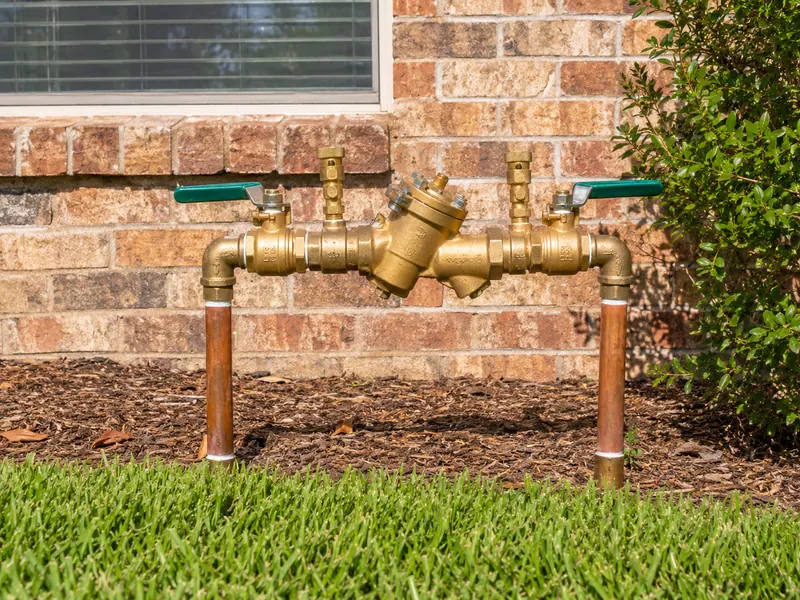
The tester must hold a TCEQ Backflow Prevention Assembly Tester license and files the test and maintenance report through BSI, the contractor SAWS uses to track compliance. SAWS says tester fees range from $40 and up. Skipping the test can bring a Class C misdemeanor fine of $200 to $2,000 per violation per day and, after notice, loss of water service.
Why does a sprinkler system need one?
An irrigation system connects drinking water to soil, fertilizer and standing water in the lawn. If pressure drops, that water can be pulled back into the pipes. The Watts video on this page explains back pressure, back siphonage and cross connections. SAWS's backflow FAQ, citing Plumbing and Fuel Gas Code Sec. 608.16.5, says lawn irrigation must be protected by one of three devices, chosen by hazard: a pressure vacuum breaker, a double-check valve assembly, or a reduced pressure principle unit. SAWS says the device is usually found in an in-ground rectangular box close to the meter.
Who can test it, and when is it due?
Only a licensed tester. TCEQ's BPAT license page says anyone who repairs or tests backflow prevention assemblies must hold a TCEQ license, renewed every three years. SAWS's annual testing page says the same for irrigation assemblies and posts a list of companies employing licensed testers, and its backflow program page sends owners to BSI to find a registered testing company. In practice that means a licensed tester who is also registered for SAWS reports.
The City ordinance, in the SAWS-hosted copy of Chapter 34, sets the timing:
- a first test when the assembly goes in, then one every year
- the signed test form submitted within 10 days of the test
- the annual report due no later than June 30
- reports kept by the owner for at least 3 years
- no return to service for a failed assembly until it is fixed or swapped out
SAWS treats a filed "failed" report as a delinquency until the assembly passes. The ordinance applies inside city limits and in the extraterritorial jurisdiction. That SAWS copy dates from April 2020; for any later amendments, the City's own code library is the place to check.
How do I check whether my test was filed?
SAWS sends due and past-due notices through BSI. Homeowners can find a registered testing company and check their property's status on BSI's customer site, which SAWS links from its backflow program page. A tester submits the report on the owner's behalf.
Annual backflow testing does not cover thermal expansion equipment or water heater relief valves, which owners still have to maintain, SAWS notes. A working backflow device is also a condition of the new landscape variance. Freeze steps for the rest of the system are in sprinklers before a freeze, and the other irrigation rules are in the rain sensor and plan report.
Next to watch The June 30, 2027 deadline for the next annual backflow test report.
Key facts
- Annual test by a TCEQ-licensed Backflow Prevention Assembly Tester
- Report due by June 30; signed form within 10 days of the test
- Tester fees from $40 and up, per SAWS
- Penalty: $200-$2,000 per violation per day; service can be cut after notice
- Check status and find testers through BSI, SAWS's tracking contractor
Sources
- SAWS — City Code Chapter 34 backflow ordinance, April 2020 PDF (checked Nov. 11, 2026)
- SAWS — irrigation assembly types and tester fees (checked Nov. 11, 2026)
- SAWS — yearly test rule and failed reports (checked Nov. 11, 2026)
- SAWS — cross-connection program and BSI tracking (checked Nov. 11, 2026)
- TCEQ — licensing for people who test or repair assemblies (checked Nov. 11, 2026)
- SAWS — March 2021 post on shutting the levers (checked Nov. 11, 2026)