Your waterW-01
How hard is San Antonio tap water?
Filed Nov. 11, 2026 · checked against 3 sources · Aquifer to Tap
San Antonio tap water runs 15 to 20 grains per gallon of hardness, SAWS says, which is naturally occurring calcium carbonate from the Edwards and Trinity aquifers and not a health hazard.
15-20 gpgtypical hardness in SAWS waterSource: SAWS Water Quality FAQs
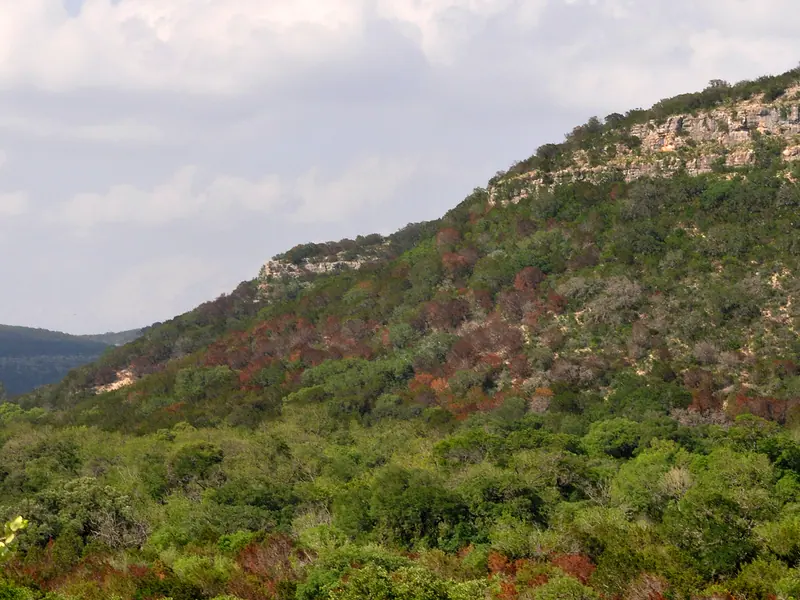
Hardness is the concentration of calcium and magnesium, stated as calcium carbonate. SAWS's water quality FAQ explains that water picks up those minerals as it moves through soil and rock, and that the typical range in its water is 15 to 20 grains per gallon (gpg). The same answer says hard water "is not a health hazard" and points to a National Research Council finding that hard water contributes a little toward dietary needs for both minerals.
What does 15 to 20 grains mean in other units?
Lab reports and test strips often use milligrams per liter (mg/L) or parts per million instead of grains. One grain per gallon is about 17.1 mg/L, so SAWS's range works out to roughly 257 to 342 mg/L as calcium carbonate. That conversion is our arithmetic, not a SAWS figure.
The last SAWS report found with a hardness line is the 2012 Water Quality Report, built on 2011 data. It listed total hardness of 198 to 316 mg/L, calcium of 60.8 to 103 ppm and magnesium of 11.2 to 20.5 ppm. Those are 15-year-old numbers, useful only as a dated reference point.
| Source | Hardness | Units | Data year |
|---|---|---|---|
| SAWS Water Quality FAQs | 15-20 | grains per gallon | not dated (page modified May 24, 2024) |
| Same range, converted | about 257-342 | mg/L as CaCO3 | our conversion |
| SAWS 2012 Water Quality Report | 198-316 | mg/L as CaCO3 | 2011 |
| Same range, converted | about 11.6-18.5 | grains per gallon | our conversion |
Why the yearly report has no hardness line
Hardness is a secondary constituent. The 2026 Water Quality Report says secondaries fall under State of Texas rules rather than EPA's, need not appear in the report, and can be found on the state's Drinking Water Watch site. No hardness reading by plant or entry point is given here; Drinking Water Watch is where to look for one. The full 2026 report summary covers what the document does list.
SAWS blends Edwards water with Vista Ridge, desalinated, Trinity and surface supplies; the supply mix is laid out separately. SAWS does not publish hardness by source or by neighborhood, so testing is the way to get one tap's number.
Testing at home
A home kit or test strip gives a reading in grains or mg/L. Kits differ, so treat the result as an estimate for that one tap. The visible effects of hard water, crust on fixtures and white flakes in hot water, are covered in white flakes, spots and scale. Whether to treat it is a comfort and appliance question, taken up in a separate report on softeners.
Next to watch Whether SAWS's next yearly report, carrying 2026 data, adds any secondary readings such as hardness.
Key facts
- SAWS: typical hardness 15-20 grains per gallon, calcium carbonate from the Edwards and Trinity aquifers
- SAWS: hard water is not a health hazard
- 2011 data (2012 report): 198-316 mg/L total hardness as CaCO3
- 1 gpg is about 17.1 mg/L
- Hardness is a state-regulated secondary, not listed in the 2026 report
Sources
- SAWS — Water Quality FAQs, hardness answer (checked Nov. 11, 2026)
- SAWS — 2012 Water Quality Report, 2011 data (PDF) (checked Nov. 11, 2026)
- SAWS — Main System Water Quality Report 2026, secondary constituents (checked Nov. 11, 2026)