Your waterW-08
White flakes, spots and scale
Filed Nov. 11, 2026 · checked against 3 sources · Aquifer to Tap
White flakes and scale in San Antonio taps are hard-water calcium carbonate, which SAWS says "will precipitate when heated or frozen," and its fix is flushing the water heater 2-3 times a year.
2-3 times a yearwater heater flushing SAWS suggests for hard-water sedimentSource: SAWS Trouble-Shooting Water Quality Concerns
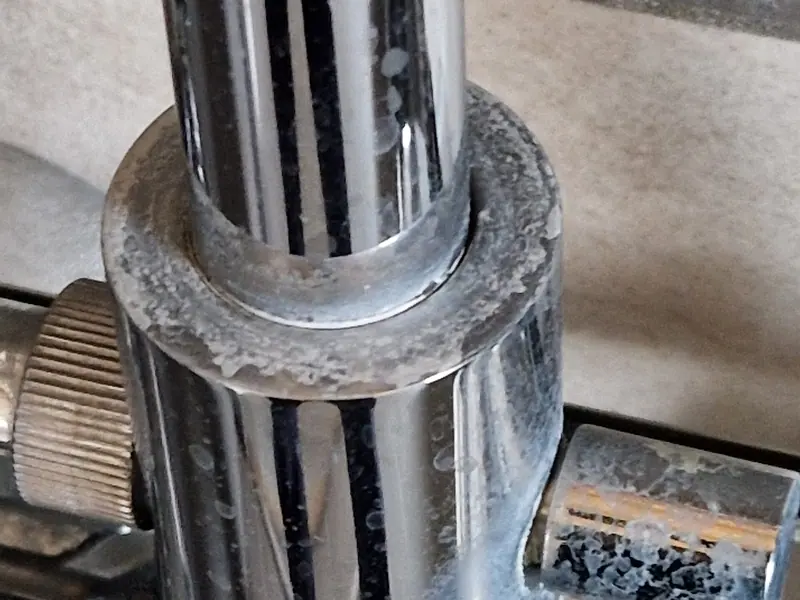
SAWS's troubleshooting table links white or light-colored sediment to hard water and recommends flushing the hot water heater "regularly, 2-3 times a year to remove loose calcium carbonate." The mineral is the same one SAWS measures at 15 to 20 grains per gallon; see SAWS's hardness range.
Why does it show up in hot water first?
SAWS's explanation is that calcium carbonate comes out of the water when it is heated, which is why its advice centers on the water heater and on clearing out the loose mineral there. Freezing does the same, by the same SAWS line. The table does not cover spots on glass, but they are the same mineral SAWS describes.
SAWS's table covers other colors too. Uniform brown particles, it says, can be resin from a water softener, in which case the softener goes on bypass and gets repaired. Milky water that clears from the bottom of a glass within a few minutes is air, which the SAWS FAQ calls harmless.
| What you see | SAWS explanation | SAWS suggestion |
|---|---|---|
| White or light sediment | hard water; calcium carbonate precipitates when heated or frozen | flush the water heater 2-3 times a year |
| Uniform brown particles | resin from a water softener | put the softener on bypass and have it repaired |
| Milky water that clears from the bottom up | air in the water | clean, complete faucet aerators |
How often to flush: two sources, one rule
SAWS says 2-3 times a year. The DOE Energy Saver Guide says to drain a quart from the tank every 3 months to remove sediment, following the manufacturer's directions. Both point to the heater's own manual, and this page does not pick between them. Step-by-step detail is in flushing a water heater.
Scale beyond the heater
Calcium carbonate does not make the water unsafe; SAWS calls hardness "not a health hazard." Scale is an appliance and cleaning issue. Some households install a softener to cut it, a choice SAWS does not recommend for health and the City requires a permit for; the trade-offs are in the softener report. A water heater left near 120°F, the temperature DOE calls safe for most homes, is covered in water heater at 120.
Key facts
- SAWS: calcium carbonate precipitates when hard water is heated or frozen
- SAWS: flush the water heater 2-3 times a year for loose calcium carbonate
- DOE guide: a quart drained each quarter, following the manufacturer
- Brown uniform particles can be softener resin, SAWS says
- Hardness is not a health hazard, per SAWS
Sources
- SAWS — Trouble-Shooting Water Quality Concerns (checked Nov. 11, 2026)
- SAWS — FAQs on cloudy water and hardness (checked Nov. 11, 2026)
- Energy Saver Guide from DOE, 2022 edition (PDF) (checked Nov. 11, 2026)